Enterprise AI adoption: the method that moves from awareness to activation
AI adoption rarely fails for technical reasons: 95 % of projects deliver no measurable impact (MIT, 2025). The method that works activates teams on their real day-to-day work and installs a permanent rhythm of adaptation.
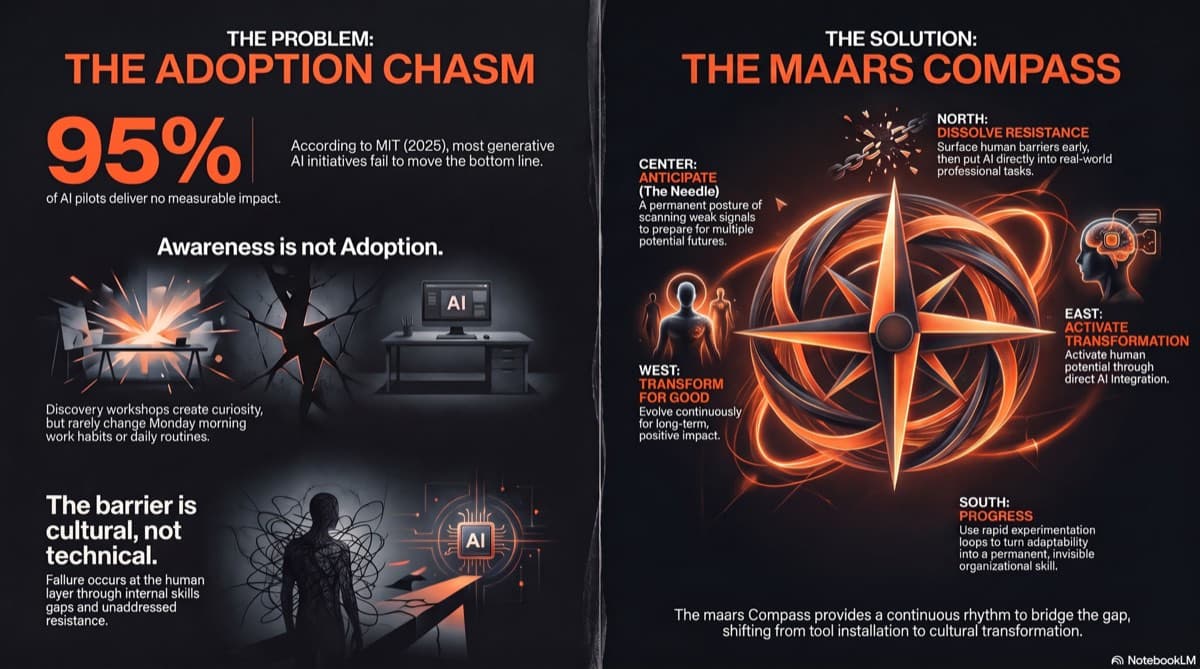
TLDR. Succeeding at AI adoption in the enterprise is not about giving access to tools: it is about activating teams on their real day-to-day work and installing a permanent rhythm of adaptation. Technology is no longer the blocker. According to MIT (2025), 95 % of enterprise generative AI pilots deliver no measurable impact, and France's INSEE identifies the internal skills gap as the leading barrier. The method that works starts with people: dissolve resistance, activate real usage, anchor through experimentation.
Key takeaways:
- Adoption rarely fails for technical reasons. It fails at the human layer.
- Awareness is not adoption. A discovery workshop does not change Monday morning work habits.
- The right unit of measure is not "did we deploy a tool" but "did the work actually change".
- Adoption is a permanent state, not a project you launch and close.
What is enterprise AI adoption?
Enterprise AI adoption is the shift from having access to AI tools to a real and lasting change in how people work. It is not signing a ChatGPT Enterprise contract or rolling out a copilot: it is the moment a team weaves AI into its daily work without thinking about it, with a measurable gain in time, quality or value.
The distinction matters. Deploying a tool is a purchasing decision. Driving adoption is organizational work. A company can license 100 % of its staff and change zero practices. That is, in fact, the most common outcome.
Why most AI projects fail (and it is not the technology)
Most AI initiatives create no value, and the cause is organizational, not technical. The 2025 data converges:
- According to MIT (Project NANDA, 2025), 95 % of enterprise generative AI pilots deliver no measurable impact on the bottom line.
- BCG (2025) finds that only 5 % of companies capture substantial value from AI at scale, while 60 % capture no material value at all.
- Gartner expects nearly 30 % of generative AI projects to be abandoned after the POC.
In France the blocker is even more explicit. Per INSEE (2024), only 10 % of companies with 10 or more employees use at least one AI technology, versus 13 % on average across the European Union. And INSEE names the leading barrier clearly: the internal skills gap, well ahead of access to solutions.
In other words: the tools are here, available and cheap. What is missing is the human capacity to absorb them, steer them and turn them into practices. That is precisely the gap technology never closes on its own.
The real blocker: awareness is not enough, you have to activate
Awareness creates curiosity, not adoption. That is the nuance most programs miss. An inspiring keynote or a discovery workshop generates enthusiasm on the day, then nothing changes in the real work of the following week.
Activating means putting AI in hand on real day-to-day work. Not a generic use case in a training room, but the specific task this person does, in their tool, with their constraints. The salesperson preparing a meeting. The HR lead screening applications. The controller building a report. Adoption happens there, in the friction of daily work, not in the strategy slide.
This is also why standalone awareness dissolves so fast: it does not touch habits, it does not survive resistance, and it installs no ritual to sustain momentum. Activation works all three.
The maars Compass method: a compass for continuous adaptation
The maars Compass method structures AI adoption as a compass rather than a linear project plan. One continuous posture at the center, four cardinal caps to travel in a loop. It comes from a lived observation inside large organizations: change fails at the human layer, not in the technology.
- Anticipate change (the needle, continuous): detect weak signals and prepare for several futures. A permanent posture, not a step.
- Clear the obstacles (North): identify and reduce the technological, organizational, cultural, managerial and human friction that slows adoption down. What blocks you is rarely the tool, almost always what nobody dared name.
- Activate your talent (East): give your people the desire, the skills, the confidence and the means to use AI on their real day-to-day work, with no theoretical detour.
- Experiment on real work (South): test AI on concrete tasks and business problems to measure what it is actually worth. A pilot that never leaves the lab proves nothing to anyone.
- Anchor what works (West): build on the experiments that worked, spread the practices and embed the useful ones into how the work gets done. Then the needle points north again.
The compass logic is not decorative. It says one precise thing: AI adoption has no finish line. Models, uses and skills keep rewriting themselves. An organization that "finished its AI project" has in fact stopped adapting.
Where to start: diagnosis, use cases, rhythm
Starting with an honest diagnosis beats launching ten pilots. The first question is not "which tool" but "where does our organization actually stand": team maturity, latent resistance, high-leverage work.
An adoption roadmap that holds rests on three principles:
- Start from the work, not the tools. Identify high-volume, high-leverage tasks by population (executives, managers, HR, sales, operations), then activate AI on them.
- Install a rhythm, not an event. Short cycles with real proof beat one big annual training with no follow-through. Adoption is measured in habits, not attendance.
- Address people first. Name and dissolve resistance before scaling. One use adopted by a convinced team beats a thousand dormant licenses.
The leader's role in AI adoption
The leader is the tipping point of adoption, not just its budget sponsor. In most companies, it is leadership that drives the rollout of AI. The context made it unavoidable: per the Siparex barometer (November 2025), 86 % of SME and mid-market leaders now see AI as a strategic priority for 2026, up from 48 % a year earlier.
At that level, the risk is not underinvesting, it is confusing budget with adoption. An executive committee that funds licenses without installing a rhythm of adaptation gets costs, not results. The leader's role is to embody the posture of anticipation, protect the time for experimentation, and demand the right metric: changed work, not the number of tools deployed.
Frequently asked questions
What is enterprise AI adoption?
It is the shift from having access to AI tools to a real and lasting change in how people work. Adoption is reached when teams weave AI into their daily work with a measurable gain, not when a tool is simply deployed.
Why do so many AI projects fail?
Because the cause is organizational, not technical. MIT (2025) measures that 95 % of generative AI pilots have no bottom-line impact, and INSEE identifies the internal skills gap as the leading barrier in France. The tools are available; what is missing is the human capacity to turn them into practices.
Why is a classic AI training not enough?
Because an awareness session creates curiosity, not adoption. It does not touch real work habits and installs no ritual to sustain usage. Activation, by contrast, puts AI in hand on each team's specific day-to-day work.
Where should AI adoption start?
With an honest maturity diagnosis, not a tool. Identify high-leverage work by population, activate AI on it in short cycles, and install a rhythm of adaptation rather than a one-off event.
How do you measure AI adoption?
By measuring changed work and value produced (time saved, quality, value created), not the number of licenses or workshop attendees. The right question is "did practices change", not "did we deploy a tool".
In short
Succeeding at enterprise AI adoption is not decided by the choice of technology, but by the organization's capacity to change its work and adapt continuously. The 2025 data confirms it: access to tools has never been wider, and the value captured stays low. The gap closes through people: dissolve resistance, activate real usage, anchor through experimentation, and make adaptability a permanent skill. That is the logic of the compass, and that is where adoption is won.
Useful resources
- INSEE, statistics on AI use by French companies (2024).
- OECD, AI adoption by firms and individuals (2026).
- MIT, Project NANDA, State of AI in Business (2025).
- BCG, AI at Work / AI Value Gap (2025).
- Bpifrance, AI awareness and training programs for executives (IA Booster, France 2030).
Related reading: AI is not a tool. It's a copilot.